
Kilowatt Calculator
A kilowatt (kW) measures power — how fast energy is used — while a kilowatt-hour (kWh) measures energy, which is what your electricity bill charges for. This calculator converts power between common units, finds kilowatts from volts and amps (including three-phase supplies), and turns running time into kWh and cost so you can compare appliances and estimate bills.
- Free to use
- No sign-up
- Runs in your browser
Kilowatt calculator
1. Power units
2. Volts and amps to kilowatts
3. Energy use and cost
Kilowatt and Energy Pack
Printable power conversion card, three-phase formula card, appliance energy log and an Excel home energy calculator.
- Conversion card (PDF)
- Formula card (PDF)
- Energy calculator (XLSX)
- Appliance log (PDF/DOCX/XLSX)
Formats: PDF, XLSX, DOCX. Instant download after payment (link valid 72 hours, up to 5 downloads). AI-assisted: the templates were drafted with AI help and reviewed and laid out before publishing.
$5.00 USD, one-time 4 files · about $1.25 each
- Instant download
- 7-day refund
- Secure checkout by Stripe
7-day money-back guarantee. Full refund within 7 days of purchase, even after you download.
Free sample: Power Conversion Card (PDF, 96 KB)
Full refund within 7 days — see the refund policy and license.
Free printables
Single sheets you can print right now, no sign-up. The full pack adds every sheet in one download plus the editable files.
 Printable Kilowatt Conversion Card
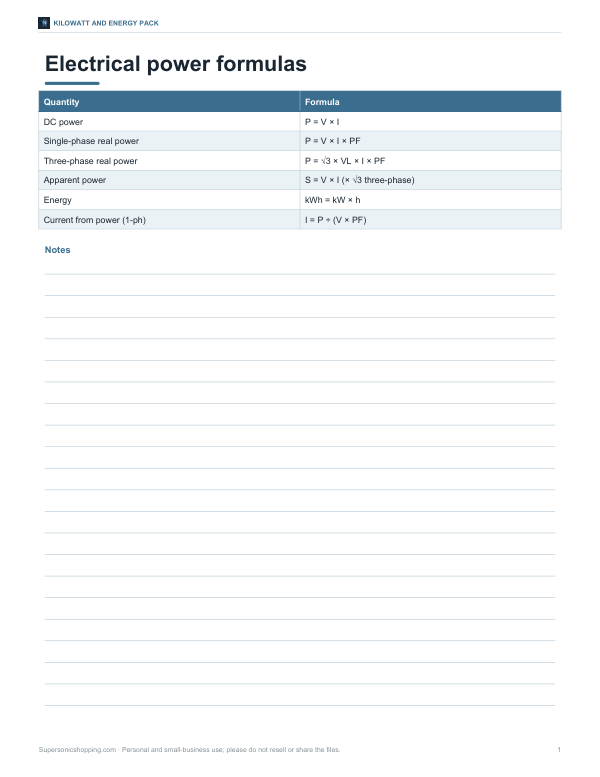 Printable Kilowatt Formula Card
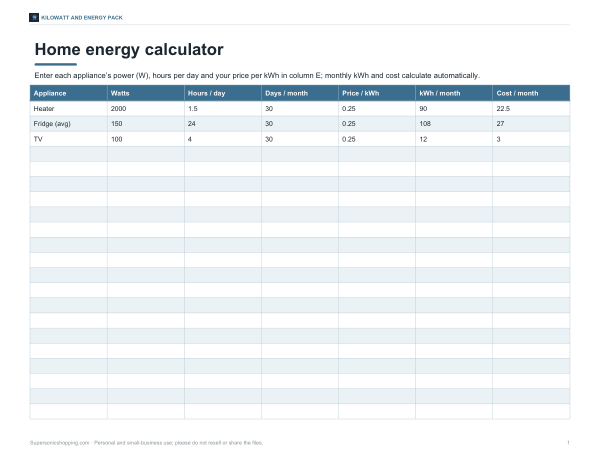 Printable Home Energy Calculator
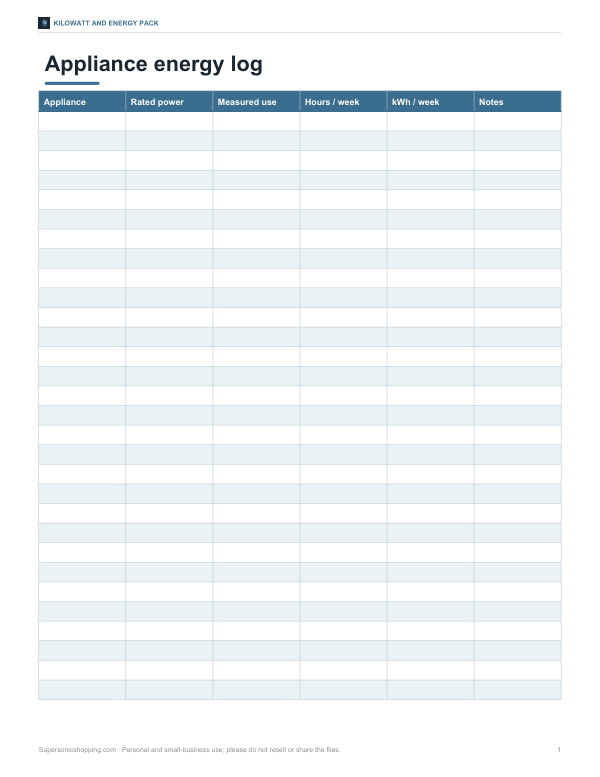 Printable Appliance Energy Log
kW vs kWh
| Term | Measures | Example |
|---|---|---|
| Watt (W) / kilowatt (kW) | Power: the rate of using energy | A 2 kW kettle uses energy at 2,000 joules per second |
| Kilowatt-hour (kWh) | Energy: power × time | The kettle running for 30 minutes uses 1 kWh |
| kVA | Apparent power in AC circuits | Used for sizing generators and transformers |
| Horsepower (hp) | Power, mostly for motors and engines | 1 hp ≈ 0.746 kW |
Your electricity bill counts kWh (often called “units”). A device’s kW rating tells you how quickly it uses them.
Power conversions
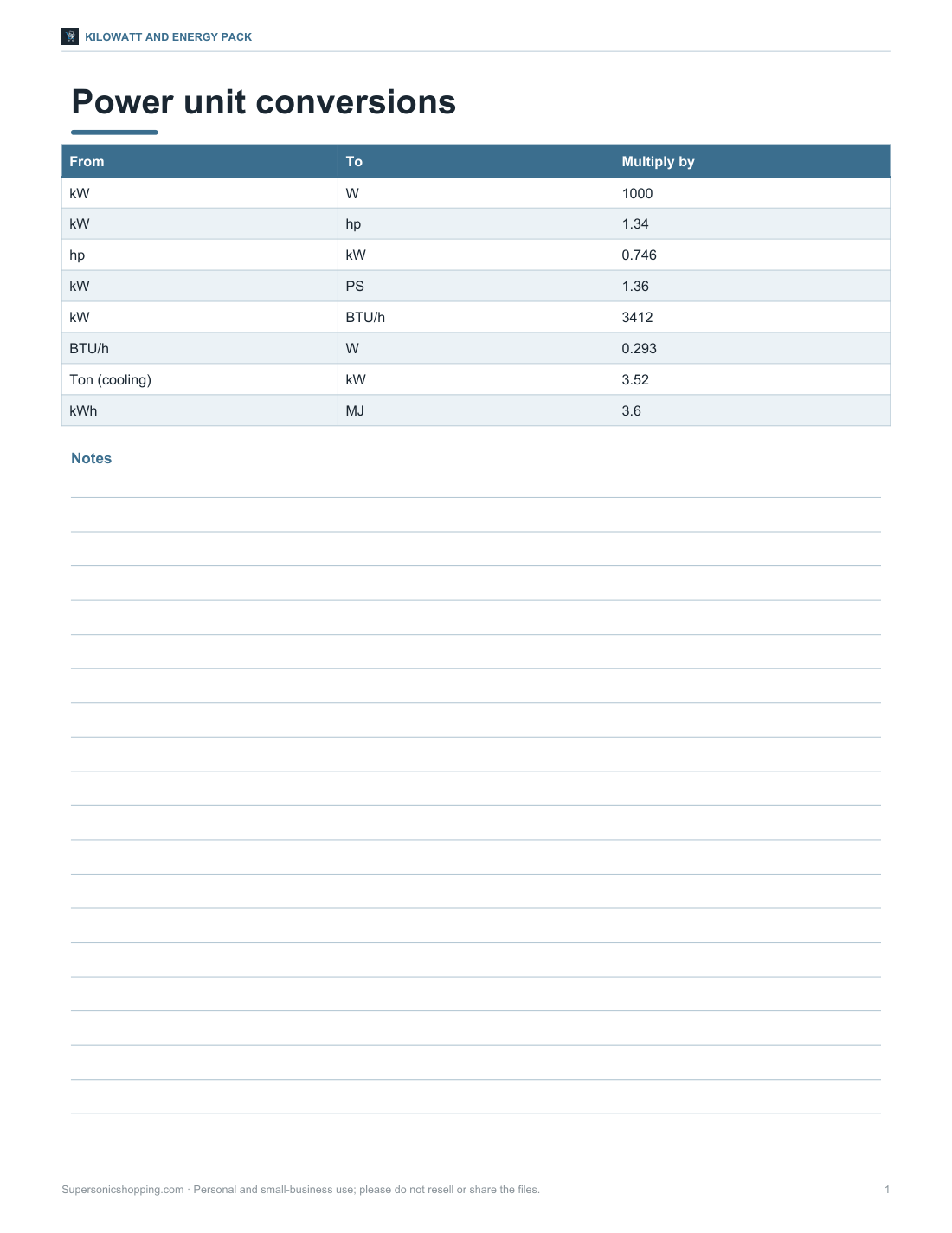
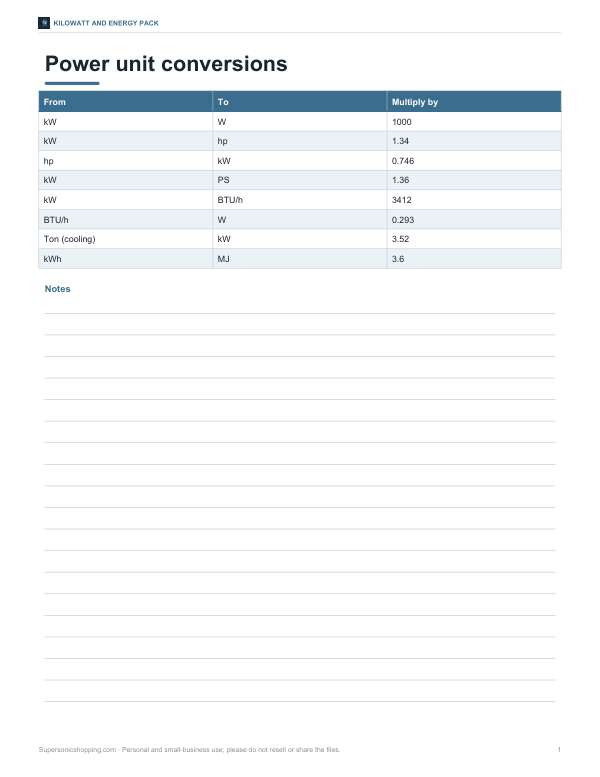
| From | To | Multiply by |
|---|---|---|
| kW | W | 1,000 |
| kW | hp (mechanical) | 1.341 |
| hp | kW | 0.7457 |
| kW | PS (metric hp) | 1.360 |
| kW | BTU/h | 3,412 |
| BTU/h | W | 0.2931 |
| Tons of cooling | kW | 3.517 |
Volts and amps to kilowatts
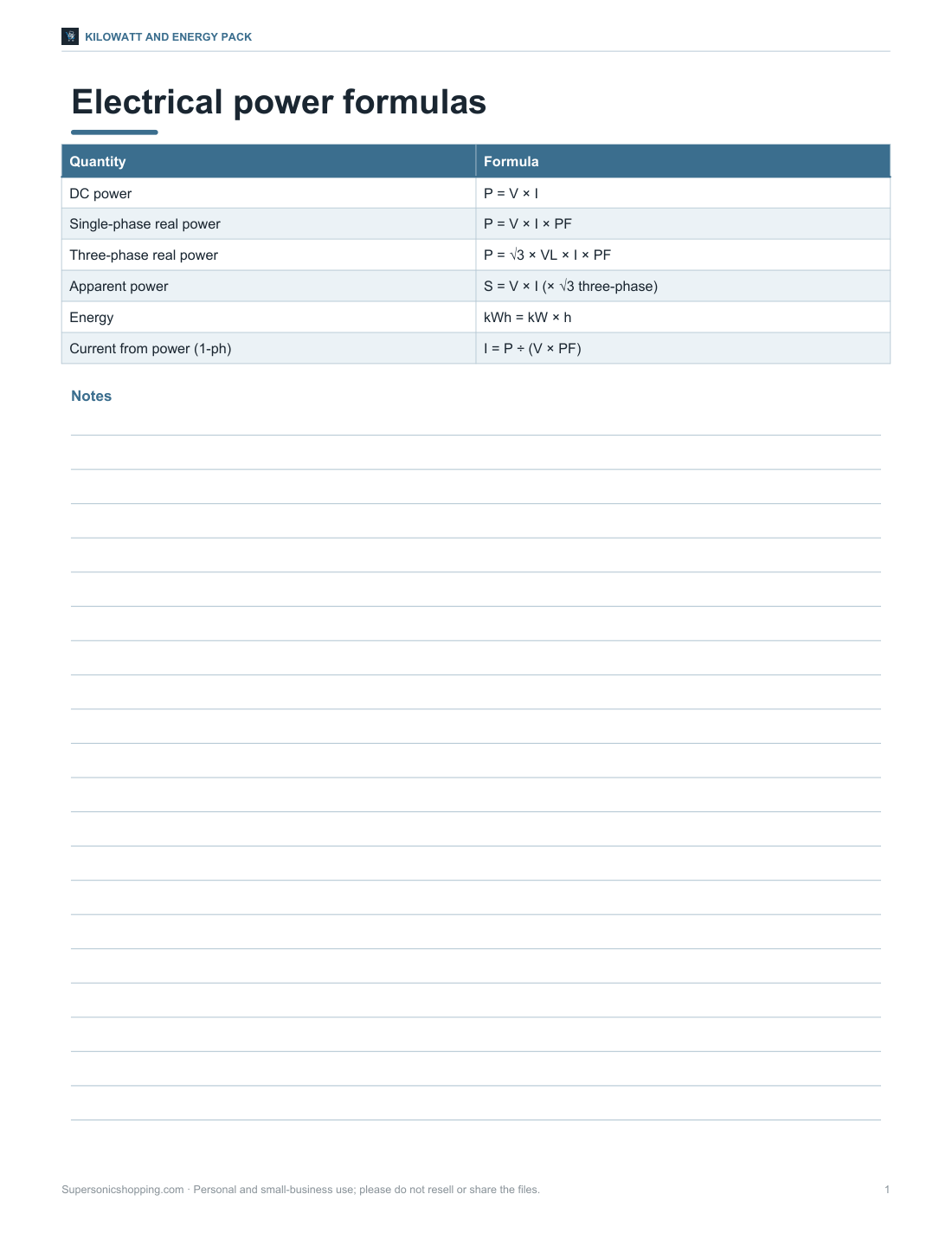
| Supply | Formula |
|---|---|
| DC | kW = V × A ÷ 1,000 |
| Single-phase AC | kW = V × A × PF ÷ 1,000 |
| Three-phase AC | kW = √3 × V(line) × A × PF ÷ 1,000 |
| Apparent power (AC) | kVA = V × A ÷ 1,000 (× √3 for three-phase) |
Power factor (PF) is 1 for purely resistive loads such as heaters and kettles, and lower (often 0.8–0.95) for motors and many electronic devices. If you don’t know it, the kVA figure gives an upper bound.
Worked examples
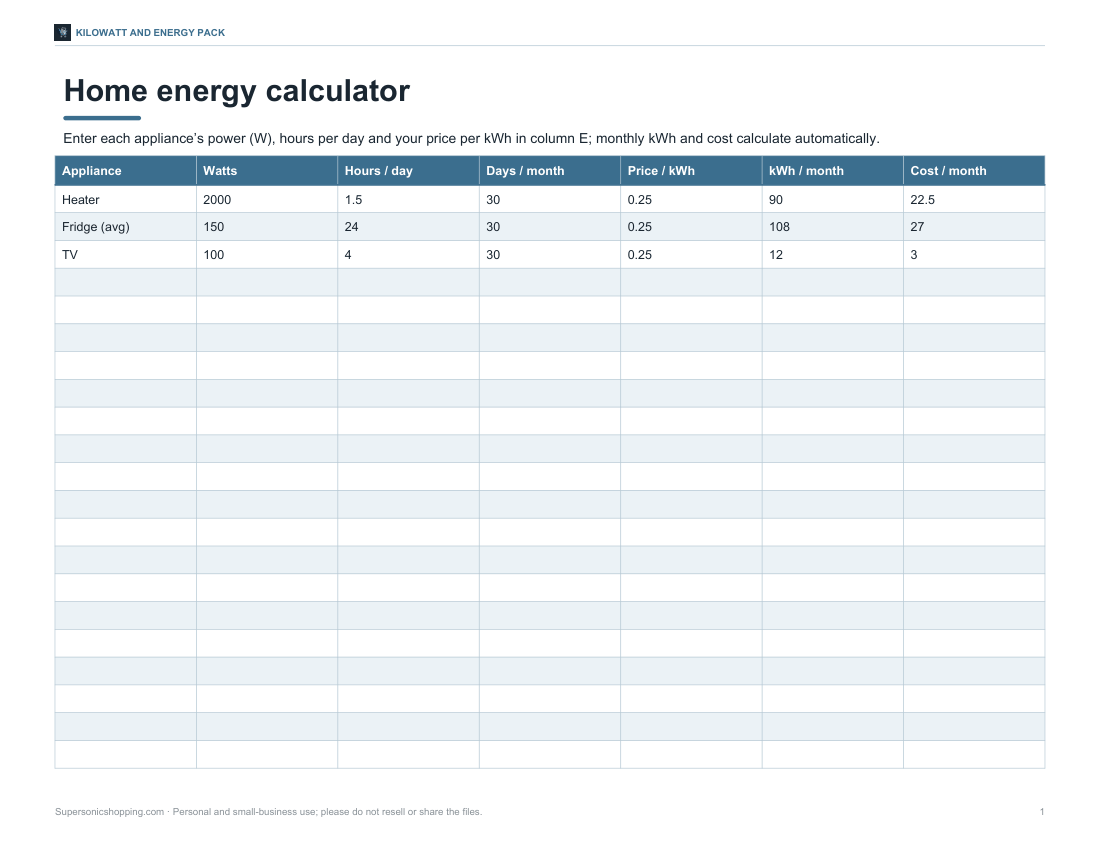
A 13 A appliance on a 230 V single-phase supply with a power factor of 1 uses 230 × 13 = 2,990 W, about 3 kW. A three-phase motor drawing 20 A at 400 V with a power factor of 0.85 uses √3 × 400 × 20 × 0.85 ≈ 11.8 kW. A 2 kW heater running 1.5 hours a day for 30 days uses 2 × 1.5 × 30 = 90 kWh; at 25 cents per kWh that is $22.50 a month.
Typical appliance power
| Appliance | Typical power |
|---|---|
| LED bulb | 5–15 W |
| Laptop | 30–90 W |
| TV (LED) | 50–150 W |
| Refrigerator (average while cycling) | 100–250 W |
| Microwave | 0.8–1.5 kW |
| Kettle | 1.8–3 kW |
| Electric oven | 2–5 kW |
| Heat pump / air conditioner | 1–5 kW |
| EV home charger | 3.7–11 kW (region dependent) |
Check the rating plate or manual for your appliance; plug-in energy monitors measure actual use.
Reading your electricity bill
Bills usually show the kWh used in the period (from meter readings or estimates), the price per kWh — sometimes different for peak and off-peak hours — and a fixed daily standing or service charge that you pay regardless of use. To check an appliance’s share, multiply its kWh by your unit price and compare with the energy part of the bill, not the total. Time-of-use tariffs make the timing of heavy loads such as laundry, dishwashers and car charging as important as the amount.
Heat pumps, heaters and efficiency
A resistive electric heater turns 1 kW of electricity into about 1 kW of heat. A heat pump moves heat rather than making it, so it can deliver roughly 2.5–4 kW of heat for each kW of electricity in suitable conditions — its coefficient of performance (COP). That is why heating costs depend so much on the type of heater, and why the kW on a heat pump’s label may describe heat output rather than electricity input; check which figure you are using.
Standby and always-on loads
Small loads add up because they run all day. A device drawing 5 W continuously uses 5 × 24 × 365 ÷ 1,000 ≈ 44 kWh a year; ten such devices use over 400 kWh. Routers, set-top boxes, smart speakers, chargers and appliances with clocks all contribute. A plug-in energy monitor shows the standby draw; switching off at the wall or using smart plugs on a schedule can trim the total.
Sizing circuits and generators
| Question | What to calculate |
|---|---|
| Will this appliance overload the circuit? | Current = watts ÷ volts (÷ PF for motors); compare with the breaker rating |
| What generator size do I need? | Add running watts; allow for motor starting surges, which can be 2–3× running power |
| How long will a battery last? | Battery kWh ÷ load kW × usable fraction |
| How much solar do I need? | Daily kWh ÷ local peak sun hours, plus losses |
These are planning estimates; electrical installation and generator connection should follow local regulations and be done by qualified people.
Reducing energy costs
- Target the biggest users first: heating, cooling, hot water and cooking.
- Use timers and thermostats to cut running hours.
- Replace old incandescent bulbs with LEDs.
- Switch off devices on standby when practical.
- Check your tariff for cheaper off-peak hours for dishwashers, laundry and EV charging.
The energy pack
The optional pack includes a printable power conversion card, an appliance energy log, an Excel home energy calculator with monthly and annual costs, and a three-phase formula card. The calculator on this page is free.
AI-assisted content
This page was drafted with AI assistance and reviewed before publishing. Electrical installation work should be done by qualified people following local regulations.
Frequently asked questions
How many watts is 1 kW?
1,000 watts.
How do I convert kW to kWh?
Multiply kW by the hours of use.
How many kW is 1 hp?
About 0.746 kW.
How do I calculate kW from amps?
Single phase: kW = V × A × PF ÷ 1,000; three phase: multiply by √3.
What is the difference between kW and kVA?
kW is real power; kVA is apparent power, which includes the effect of power factor.
How much does it cost to run a 2 kW heater?
2 kWh per hour × your price per kWh — at 25 cents, 50 cents an hour.
How many kWh does a house use?
It varies widely with size, climate and heating; your bill shows your actual use.